

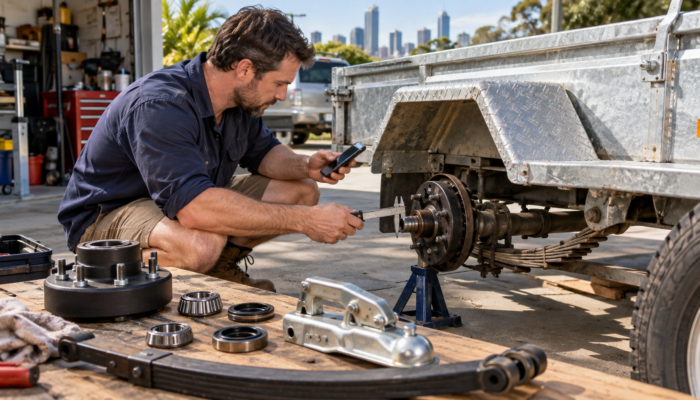
Questions to Ask Before Buying Trailer Parts
The cheapest trailer part on the internet is rarely the cheapest once you add re-fitting, downtime, repeat freight and a failed inspection. Trailers punish guesswork more than most equipment because every load rating, coupling, bearing and brake has to work together. Ask the right questions before you pay and you’ll avoid most expensive mistakes.
What is my trailer on paper?
Trailers look simple from the side of the road. Underneath, they’re a set of matched dimensions that don’t forgive approximations.
Start with the basics on the compliance plate and registration papers: make, model, year and VIN. That string of characters ties your trailer back to how it left the factory and tells a parts supplier which axle stubs, hub bores, coupling heights and spring mounts were fitted as standard. Two trailers that look identical can sit on different stubs or carry different spring hangers because a builder changed suppliers mid-run. Without the identity details, you’re guessing.
Take a photo of the compliance plate and keep it on your phone. You’ll need the number stamped on it every time you order bearings or seals, and you’ll need it again if there’s ever a warranty claim or roadside check. We’ve seen owners order by trailer length alone and end up with hubs that won’t slide onto the stub. That mistake means a return freight charge and a lost weekend.
If the plate is missing or unreadable, stop and sort that out first. Record the stamped VIN on the drawbar or chassis rail and talk to the manufacturer or registration authority about a replacement plate before you spend money on running gear. You don’t want to build new parts onto a trailer whose identity you can’t prove.
What do the weight numbers allow?
Every trailer has a legal ceiling, and its parts have to operate under it. That ceiling is stamped on the compliance plate.
ATM is the total loaded weight the trailer is allowed to carry on its own wheels and hitch. GTM is the loaded weight carried by the trailer axles when it’s hitched up. Tare weight is what the trailer weighs empty. Put those figures together and you get your real payload by subtracting tare from ATM, while GTM tells you the load carried by the axle or axles.
These figures guide every parts order. Axles, springs, brakes and tyres must be rated at or above the plated masses. If your ATM is 2000 kg, you can’t fit a pair of springs rated to 800 kg each and call it done. The numbers have to stack up with margin to spare. We always check quoted parts against ATM for total capacity and against GTM for axle and suspension load.
Write the figures down before you shop. Keep tare weight in the same note because owners often forget how much toolboxes and spare wheels add after a repair. A trailer that was light when new can run close to its limits once it’s fitted out for work.
What can the tow vehicle handle?
A trailer part has to work with the vehicle doing the pulling.
Pull out the tow vehicle’s handbook and note the maximum braked towing mass and allowable tow ball download. Those figures help decide which coupling and brake setup makes sense. A 50mm ball coupling suits many road trailers and is simple to hitch, while a DO35 coupling suits rough tracks where extra articulation helps. A pintle hook suits heavy plant trailers where a ball would cop too much punishment. They aren’t interchangeable once you consider load ratings and hitch height.
Brakes need the same cross-check. If the trailer runs electric brakes, the in-cab controller has to communicate cleanly with the magnets on the trailer axles. Old time-delay controllers and modern proportional controllers don’t feel the same underfoot, and some combinations need a specific wiring setup to avoid grab or lag. Ask what controller the brake assembly was designed around and what axle load it’s rated to stop.
Don’t guess tow ball download. Too little and the trailer sways; too much and the front of the tow vehicle goes light. The coupling you choose sets hitch height and travel, so it feeds directly into that balance.
Who are you actually buying from?
Price is easy to compare. Backup is harder to judge, but it’s what keeps trailers moving.
Before you pay, ask how the supplier handles warranty and returns. Find out if the part is on the shelf or still on a slow boat, and whether you can ring someone who knows bearings from bushings and will read a part number back correctly. A cheap deal loses its shine when the wrong hub arrives on a Friday afternoon and no one answers the phone until Tuesday.
This is where supplier support earns its keep. When searching for trailer parts brisbane, favour suppliers who can check part numbers and measurements from photos, confirm component suitability and explain freight, returns and warranty arrangements before you order. Those checks can prevent errors such as ordering a seal with the wrong inner diameter or a spring with the wrong camber.
Keep proof of everything. Save the invoice with part numbers and load ratings, along with any fitment notes the supplier gives you. If a coupling or axle ever gets questioned at inspection, that paperwork shows you bought in good faith and to specification.
Is the part compliant for road use?
Trailers are governed by design rules. A part that looks right can still be wrong on paper.
Ask for written confirmation that the part meets ADR requirements for its class. Couplings are the clearest example because ADR 62/02 sets the rules for mechanical connections between vehicles. A coupling stamped with its rating and standard number is traceable. One without markings is a gamble, even if the bolt holes line up. Keep that confirmation with your receipt so you can show it at inspection if asked.
Non-compliance can cause problems well beyond the initial purchase. An unrated coupling or under-rated brake assembly can trigger a defect notice and give an insurer a reason to dispute a claim after an incident. No one wants to argue about fine print on the side of the road. We treat missing compliance markings the same way we treat missing load ratings: walk away.
This check also applies to second-hand parts. A used coupling might have worn jaws or a stretched latch that no longer holds tolerance. A used axle might have been de-rated by rust or a previous weld repair. If the supplier can’t confirm the standard and rating in writing, the price doesn’t matter. Move on to a part with papers.
What is it made from and how will it last?
Two parts can share a part number and have very different working lives. The difference comes down to metal and finish.
Ask what grade of steel sits under the paint and how it was protected. Hot-dipped galvanising bonds zinc to the steel inside and out, so stone chips don’t turn into rust streaks in the first wet season. Painted mild steel can look tidy on the shelf and still bubble around welds and bolt holes after a few launches at the ramp. We’re not against painted parts, but we want to know where they’ll be used and whether the saving is worth an earlier replacement.
The same logic applies when comparing aftermarket and genuine parts. Some aftermarket parts match the original dimensions and steel grade while costing less. Others cut corners on heat treatment or thread fit. Ask the supplier to explain the difference in plain terms, including dimensions, steel grade, coating thickness and rating. If they can’t, you don’t have enough information to judge value.
Think about how the trailer is used. A farm trailer that sits in mud needs more coating protection than a highway box trailer that sleeps in a shed. Match the material to the job and you won’t pay twice.
Have you measured what is actually fitted?
Catalogue listings reward careful measuring. Tape measures beat memory.
Axle track width is measured from hub face to hub face with the hubs on. That number has to clear your mudguards and sit square under your spring centres. A 20 mm error can push tyres into the guards on full bounce. Measure twice and write it down with the axle capacity and wall thickness if you can see it.
Wheels and hubs depend on stud pattern and PCD. Count the studs and measure the pitch circle diameter across the centres as the supplier describes. A six-stud wheel with the wrong PCD won’t seat, no matter how close it looks. Pull one bearing set and read the numbers stamped on the bearing and seal. Bearings are cut to suit the stub to fractions of a millimetre, so close enough fails when speed and heat build.
Leaf springs need eye-to-eye centres measured unloaded, along with the width and load rating from the tag if it’s still legible. Shackle kits wear with springs, and bolt holes oval out, so check pins and hangers while you’re under there. Photos help. Lay the tape in the photo so the supplier sees the same number you see and there’s no disagreement later.
Do pairs, torque and tyres get the same attention?
Wear parts work as a team. Replace them that way.
Leaf springs sag together and bearings wear together. Fit both sides at once so ride height stays even and braking stays straight. Keep the old bearing numbers and seal sizes until the job is done, then ask the supplier for torque figures and pre-load steps for your axle type before tightening anything. Guessing the tightness of a hub nut shortens bearing life quickly.
Tyres deserve the same care. Check load index and speed rating against your ATM with gear aboard, then set working pressure to the maker’s figure for that load. Under-inflation increases heat build-up and flex, raising the risk of premature tyre failure. That one check matters as much as any steel part.
Tow empty first, then load up and check the pressures again.
The cheapest part stops being cheap when you fit it twice. Know your trailer and respect its weight limits. Buy compliant gear that suits your tow vehicle, and measure before you order. Do that and the parts you bolt on will stay on. That’s how trailers stay safe and legal.